
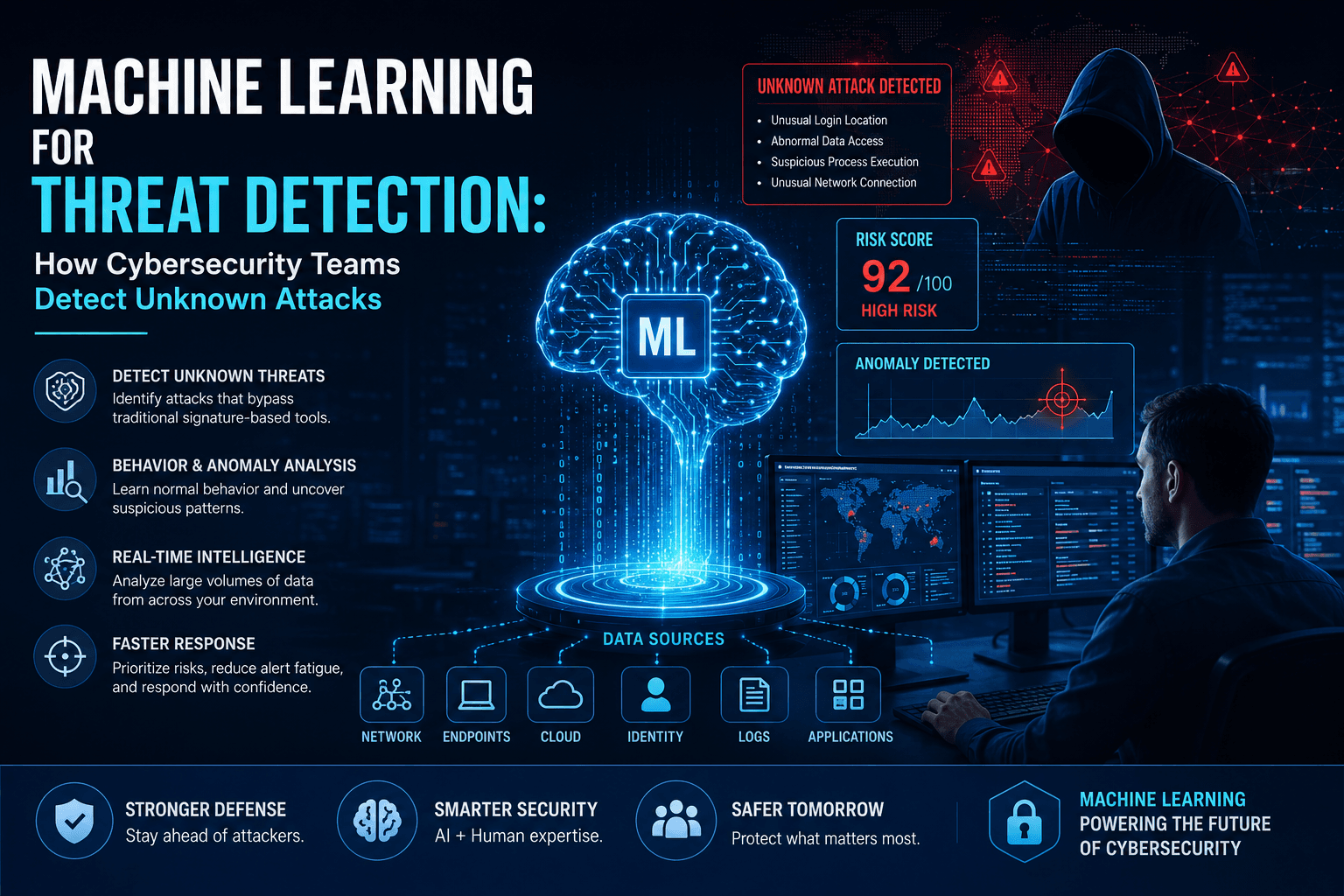
Machine learning for threat detection has become an important cybersecurity capability as organizations face increasingly complex and unknown cyber attacks. Traditional security tools often depend on known signatures, predefined rules, and historical indicators of compromise. Although these methods remain valuable, they may fail when attackers use new malware variants, stolen credentials, living-off-the-land techniques, or abnormal behavioral patterns that do not match existing detection rules. Machine learning threat detection addresses this limitation by analyzing large volumes of security data, learning normal behavior, identifying anomalies, and supporting faster investigation of suspicious activity. This article examines how cybersecurity teams use machine learning to detect unknown attacks across networks, endpoints, cloud environments, user accounts, and application systems. The article also discusses common machine learning methods, practical use cases, benefits, limitations, and best practices for integrating machine learning into security operations. The analysis concludes that machine learning does not replace cybersecurity professionals, but it strengthens their ability to detect hidden threats, reduce alert fatigue, and respond to evolving cyber risks more effectively.
Cybersecurity teams operate in an environment where threats change continuously. Attackers no longer rely only on simple malware or obvious network intrusion attempts. Modern cyber attacks often involve stolen credentials, social engineering, automated scanning, supply chain compromise, cloud misconfiguration, phishing campaigns, malicious scripts, and advanced persistence techniques. Many of these attacks are designed to avoid traditional detection tools by blending into normal business activity. Traditional threat detection methods usually depend on known signatures, fixed rules, and previously identified malicious indicators. For example, antivirus tools may detect a file based on a known malware hash. Firewalls may block traffic from a known malicious Internet Protocol address. Security information and event management platforms may generate alerts when a predefined rule is triggered. These controls remain important, but they are most effective when the threat is already known. Unknown attacks create a different challenge. A new malware variant may not match any existing signature. A compromised employee account may appear legitimate because the attacker uses a valid username and password. A cloud attacker may use approved application programming interface calls in an abnormal way. A malicious insider may slowly access sensitive files over time without triggering a single obvious rule. Machine learning for threat detection helps address these challenges by shifting security analysis from purely rule-based detection to behavior-based detection. Instead of asking only whether an event matches a known threat, machine learning systems examine whether the event appears unusual, risky, or inconsistent with normal behavior. This approach gives cybersecurity teams a stronger ability to identify unknown attacks before they become major incidents.
Machine learning for threat detection refers to the use of algorithms that analyze cybersecurity data, identify patterns, and detect suspicious activity. These algorithms can learn from historical data, current behavior, and large-scale security events. The main goal is to help security teams identify threats that may be difficult to detect manually or through traditional rules. Machine learning threat detection can be used in several areas of cybersecurity, including malware analysis, phishing detection, network intrusion detection, endpoint protection, cloud security monitoring, identity and access management, threat intelligence, and threat hunting. The technology works by processing data from logs, devices, users, applications, endpoints, servers, and cloud platforms. A basic example involves user login behavior. A machine learning model can learn that an employee usually logs in from California during business hours using a specific device. If the same account suddenly logs in from another country at midnight, accesses sensitive files, and attempts to create new administrative permissions, the model may identify the behavior as suspicious. Each individual action may not confirm an attack, but the combined behavior may indicate account compromise. This type of analysis is difficult with simple rules because normal behavior varies across users, departments, applications, and business operations. Machine learning allows threat detection systems to adapt to patterns and identify deviations that may indicate risk.
Unknown attacks are difficult to detect because they do not always match known indicators of compromise. Many traditional security tools are effective when the malicious file, domain, hash, signature, or behavior pattern is already documented. However, attackers frequently change their methods to avoid detection. For example, malware authors may slightly modify malicious code so that the file hash changes. Phishing attackers may use new domains, new email templates, and new social engineering techniques. Cloud attackers may use legitimate credentials and approved management tools. Advanced attackers may move slowly through a network to avoid generating obvious alerts. Another reason unknown attacks are difficult to detect is the volume of security data. Modern organizations generate large amounts of logs every day from firewalls, routers, servers, cloud platforms, endpoint devices, identity providers, databases, and business applications. Human analysts cannot manually review every event. Even when alerts are generated, security teams may face alert fatigue because many alerts are low priority or false positives. Machine learning threat detection helps solve this problem by analyzing large datasets and identifying suspicious patterns that may not be visible through manual review. It can connect weak signals across different systems and produce a stronger risk indication. For example, one unusual login may not be enough to trigger a serious alert. However, an unusual login followed by privilege escalation, abnormal file access, and data transfer to an unfamiliar destination may indicate a serious threat.
Machine learning detects unknown attacks by focusing on patterns, anomalies, and behavior rather than relying only on known signatures. The process usually begins with data collection. Cybersecurity tools collect information from network traffic, endpoint activity, authentication logs, cloud services, application events, email systems, and threat intelligence feeds. After collection, the data is cleaned and prepared for analysis. The machine learning model then learns from the data. In some cases, the model learns what normal activity looks like. In other cases, the model learns the difference between known malicious and legitimate activity. When new events occur, the model compares them against learned patterns and assigns a risk score or generates an alert. For example, machine learning can detect unusual network communication. If a workstation that usually communicates only with internal systems suddenly begins sending large volumes of data to an unfamiliar external server, the behavior may be flagged as suspicious. The system may not know whether the external server is malicious, but the abnormal behavior can justify investigation. Machine learning can also identify suspicious endpoint behavior. A file may not match any known malware signature, but it may attempt to disable security tools, modify registry keys, create persistence, or communicate with unusual domains. These behaviors may indicate malware activity even when the file itself is unknown. In cloud environments, machine learning can detect abnormal application programming interface usage. For example, if a user account suddenly performs rare administrative actions, accesses storage locations outside normal scope, or creates new access keys, the system may flag the activity as risky.
Different types of machine learning can support cybersecurity threat detection. Each method has strengths and limitations depending on the available data, security objective, and threat environment. Supervised learning uses labeled data. The model is trained with examples that are already marked as malicious or legitimate. This method can be useful for phishing detection, malware classification, spam filtering, malicious domain identification, and known attack recognition. The main limitation is that supervised learning depends on accurate labeled datasets. If the model has not learned from similar attacks, detection may be less effective. Unsupervised learning does not require labeled data. Instead, the model searches for patterns, clusters, and anomalies. This method is especially useful for unknown attack detection because many unknown threats do not have labels. Unsupervised learning can identify unusual login behavior, abnormal network traffic, unexpected file access, or strange application activity. Semi-supervised learning combines a small amount of labeled data with a larger amount of unlabeled data. This approach can be useful in cybersecurity because fully labeled security datasets are often difficult to maintain. Many events may not be clearly malicious or benign until further investigation. Deep learning can process complex data such as large log datasets, malware behavior sequences, natural language in phishing emails, or network traffic patterns. Deep learning may improve detection accuracy in some cases, but it may also require more computing resources and stronger model governance. The most effective machine learning threat detection programs often use a combination of methods rather than depending on a single model.
Machine learning security analytics involves using machine learning to analyze security data and generate meaningful insights for cybersecurity teams. Security analytics tools collect information from multiple systems and use models to detect unusual activity, correlate related events, and prioritize risks. This capability is especially valuable in modern security operations centers. Analysts often receive a large number of alerts from different tools. Some alerts may be serious, while others may be false positives. Machine learning can help reduce noise by identifying which alerts are more likely to represent real threats. For example, a security analytics system may examine login patterns, endpoint behavior, network activity, and cloud access logs together. If several low-risk events occur in a suspicious sequence, machine learning may combine them into a higher-risk alert. This helps analysts focus on incidents that deserve immediate attention. Machine learning security analytics can also support long-term trend analysis. It can detect gradual changes in user behavior, increasing failed login attempts, unusual data access patterns, or growing communication with suspicious infrastructure. These insights can help organizations identify risks before a full breach occurs.
Threat intelligence provides information about attackers, tactics, techniques, procedures, malware, vulnerabilities, indicators of compromise, and emerging cyber risks. Machine learning threat intelligence improves this process by helping security teams analyze large amounts of threat data more efficiently. Threat intelligence sources may include open-source intelligence, dark web monitoring, malware repositories, vulnerability databases, domain reputation feeds, phishing reports, and internal incident data. Manually analyzing all of this information is difficult. Machine learning can classify indicators, identify relationships, group similar threats, and highlight patterns that may indicate active campaigns. For example, machine learning may identify that several suspicious domains share similar registration patterns, hosting infrastructure, and connection behavior. Even if the domains are new and not yet listed as malicious, the pattern may suggest that they belong to a phishing or malware campaign. Machine learning can also help enrich alerts by connecting internal security events with external intelligence. If an internal system communicates with a domain that resembles infrastructure used in previous attacks, the risk score may increase. This helps analysts make faster and better decisions.
Machine learning threat hunting helps cybersecurity analysts proactively search for hidden threats. Traditional alert-based security depends on tools generating alerts first. Threat hunting takes a more proactive approach by assuming that attackers may already be present in the environment and searching for evidence of compromise. Machine learning improves threat hunting by identifying unusual behavior patterns that may not trigger traditional alerts. Analysts can use machine learning to find rare events, unusual user activity, abnormal process execution, suspicious network relationships, and unexpected data movement. For example, a threat hunter may use machine learning to identify user accounts that behave differently from similar users. If one finance employee suddenly accesses engineering servers, downloads unusual files, and logs in from a new device, the activity may deserve investigation. Machine learning can also group similar events together. This helps threat hunters identify attack campaigns, compromised systems, or coordinated activity across multiple endpoints. Instead of reviewing thousands of separate logs, analysts can focus on clusters of suspicious behavior. Threat hunting still requires human expertise. Machine learning can highlight suspicious patterns, but analysts must understand the business context, validate evidence, and determine whether the activity represents a real threat.
Machine learning for threat detection can be applied across many cybersecurity use cases. One common use case is malware detection. Attackers frequently modify malware to avoid signature-based tools. Machine learning can analyze file behavior, execution patterns, permissions, code structure, and system changes to detect malware-like behavior. Another use case is phishing detection. Machine learning can examine email sender reputation, message structure, links, attachments, subject lines, and language patterns. This helps identify phishing emails even when attackers use new templates or domains. Network intrusion detection is another important use case. Machine learning can analyze traffic volume, connection frequency, protocol usage, data transfer patterns, and communication destinations. Abnormal activity may indicate scanning, command-and-control communication, lateral movement, or data exfiltration. User and entity behavior analytics is also widely used. This approach studies normal behavior for users, devices, and applications. If behavior changes significantly, the system may generate an alert. This can help detect insider threats, compromised credentials, privilege misuse, and unauthorized access. Cloud security monitoring is another growing area. Cloud environments include many users, services, application programming interfaces, containers, workloads, and storage systems. Machine learning can detect unusual cloud activity such as abnormal access requests, suspicious identity behavior, rare administrative actions, and unexpected data movement.
Machine learning threat detection provides several benefits for cybersecurity teams. One major benefit is improved detection of unknown threats. Because machine learning can detect abnormal behavior, it may identify attacks that do not match existing signatures. Another benefit is faster analysis. Security teams often work with large amounts of data and many alerts. Machine learning can process this information quickly and highlight suspicious events that require attention. Machine learning can also reduce alert fatigue. Security analysts often receive too many alerts, and many alerts may not represent real threats. By prioritizing alerts based on risk, machine learning can help analysts focus on the most important incidents. Another benefit is better context. Machine learning can combine signals from multiple systems. A single event may look harmless, but multiple related events may indicate an attack. This ability to connect events improves detection quality. Machine learning also supports scalability. As organizations grow, the amount of security data increases. Machine learning can help analyze data across large environments, including remote workers, cloud infrastructure, hybrid networks, and distributed applications.
Although machine learning threat detection is powerful, it has limitations. One major limitation is data quality. Machine learning models depend on accurate, complete, and relevant data. Poor data can lead to poor detection results. False positives are another challenge. Not every unusual event is malicious. A traveling employee, a new software deployment, a system update, or a business process change may create abnormal behavior. Analysts must review alerts carefully before concluding that an attack has occurred. False negatives are also possible. Attackers may attempt to imitate normal behavior, move slowly, or avoid actions that appear suspicious. No machine learning system can detect every attack. Model explainability is another concern. Some machine learning models may generate alerts without clearly explaining why an event was considered risky. Cybersecurity teams need understandable alerts so that analysts can investigate effectively. Adversarial attacks are also a risk. Attackers may attempt to manipulate data, poison training datasets, or change behavior to evade detection. Organizations must protect machine learning systems and monitor model performance over time.
Cybersecurity teams should follow strong best practices when using machine learning for threat detection. First, organizations should collect high-quality security data from important sources such as endpoints, identity systems, cloud platforms, network devices, applications, and threat intelligence feeds. Second, machine learning should be combined with traditional security controls. Signature-based detection, rule-based alerts, firewalls, endpoint protection, identity controls, and threat intelligence remain important. Machine learning should strengthen these controls rather than replace them. Third, organizations should monitor model performance regularly. Cyber threats change over time, and normal business activity also changes. Models must be reviewed and updated to remain effective. Fourth, human analysts should remain central to the detection and response process. Machine learning can identify suspicious activity, but analysts must validate alerts, investigate incidents, understand context, and coordinate response. Fifth, organizations should document detection logic, risk scoring methods, data sources, and response procedures. Documentation supports governance, audit readiness, and operational consistency. Sixth, cybersecurity teams should integrate machine learning alerts with incident response workflows. Alerts should include enough context for analysts to understand the risk and take action quickly.
Machine learning does not replace cybersecurity professionals. Instead, it helps them work more effectively. Cybersecurity requires judgment, context, experience, and decision-making. Analysts understand business operations, system architecture, attacker behavior, compliance requirements, and organizational risk. Machine learning can process large datasets, identify unusual patterns, and prioritize alerts. Human analysts can investigate the alerts, determine whether activity is malicious, and decide how to respond. This collaboration improves security operations. For example, a machine learning model may flag unusual data access by an employee account. A human analyst may investigate and discover that the employee recently changed roles, or that the account has been compromised. The model provides the signal, but the analyst provides the judgment. The strongest cybersecurity programs use machine learning as a decision-support tool. It helps teams detect unknown attacks faster, but human expertise remains necessary for accurate investigation and response.
The future of machine learning for threat detection will likely include deeper integration with security operations centers, cloud security platforms, endpoint detection tools, identity systems, and threat intelligence platforms. As attackers use automation and artificial intelligence, defenders will need stronger behavior-based detection capabilities. Future systems may use machine learning to support automated investigation, attack path analysis, adaptive risk scoring, and faster incident response. Security teams may also use machine learning to identify software supply chain risks, detect abnormal application behavior, and monitor artificial intelligence systems themselves. However, future success will depend on governance and responsible implementation. Organizations must ensure that machine learning models are accurate, secure, explainable, and aligned with business risk. Poorly managed machine learning can create false confidence or unnecessary alerts. The future of cybersecurity will not depend only on technology. It will depend on how well organizations combine people, processes, data, and intelligent detection systems.
Machine learning for threat detection is becoming a critical part of modern cybersecurity. Unknown attacks are difficult to detect because they often avoid known signatures, use legitimate credentials, imitate normal behavior, or change tactics quickly. Traditional security tools remain important, but they are not enough to detect every modern cyber threat. Machine learning threat detection helps cybersecurity teams identify suspicious behavior, detect anomalies, analyze large volumes of security data, support threat intelligence, and improve threat hunting. It can be used for malware detection, phishing detection, network intrusion detection, cloud security monitoring, endpoint protection, and user behavior analytics. At the same time, machine learning is not a complete solution by itself. It depends on quality data, careful tuning, human validation, and continuous monitoring. Cybersecurity teams must combine machine learning with strong security controls, skilled analysts, documented processes, and effective incident response. When implemented correctly, machine learning threat detection strengthens an organization’s ability to detect unknown attacks before they cause serious harm. It gives cybersecurity teams better visibility, faster analysis, and stronger defense against evolving cyber threats.