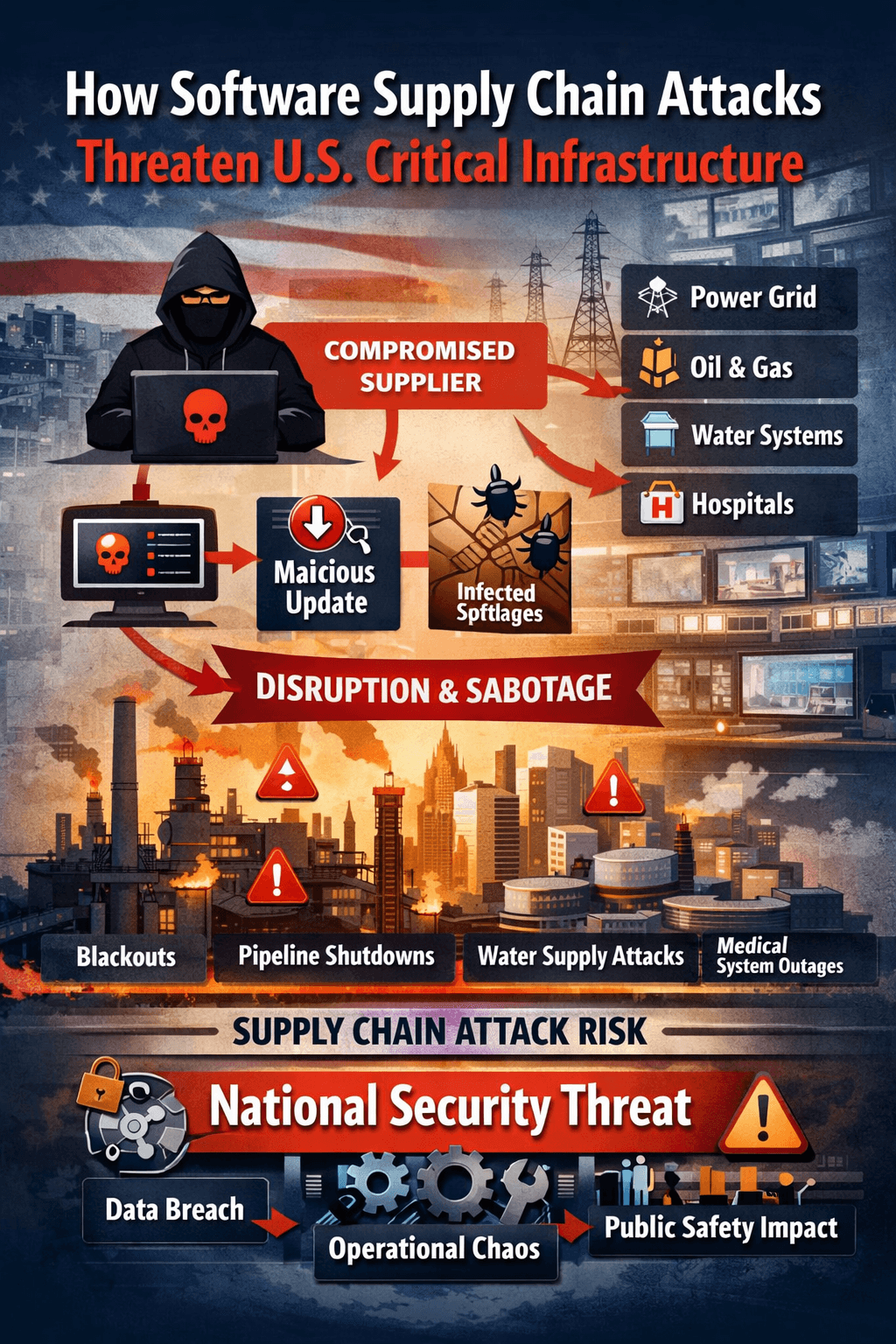
Software has become the connective tissue of U.S. critical infrastructure. Power generation and transmission, oil and gas pipelines, water treatment, transportation systems, hospitals, emergency services, financial networks, and telecommunications all depend on software-driven control and business systems. That reliance is a double-edged sword: software increases efficiency and visibility, but it also creates a path for adversaries to compromise essential services at scale. Among the most dangerous modern cyber threats are software supply chain attacks—incidents where attackers compromise trusted software, updates, dependencies, or vendor infrastructure so that the malicious activity reaches downstream customers “legitimately,” often through routine installations or patches. Instead of attacking a utility, hospital, or transportation agency head-on (where defenses may be stronger), adversaries poison something the target already trusts: a vendor update server, a build pipeline, a popular open-source package, or a managed service provider. In a nation where critical infrastructure spans thousands of organizations—many with tight budgets, long technology lifecycles, and complex vendor ecosystems—software supply chain compromise has become a strategic weapon
When people hear "supply chain," they often imagine physical goods. In software, the supply chain includes: 1. Source code and dependencies Modern applications are assembled from frameworks, libraries, containers, and third-party components. A single enterprise product can include thousands of transitive dependencies. 2. Build systems and CI/CD pipelines The tools that compile, package, test, sign, and release software are themselves targets. If an attacker can modify artifacts during build, the end product may carry a backdoor while the source code looks clean. 3. Code signing keys and release infrastructure If attackers steal signing certificates or compromise update mechanisms, they can distribute malware in a way that looks authentic and passes many defenses. 4. Vendor and managed service relationships Critical infrastructure operators frequently rely on contractors and managed service providers for monitoring, endpoint management, network management, patching, and identity services—each a potential entry point. What makes supply chain attacks uniquely dangerous is the trust transfer: when an organization trusts a supplier, the supplier's compromise can become the organization's compromise—without the victim making any "obviously risky" choice.
Critical infrastructure has characteristics that make supply chain threats more severe and harder to mitigate: 1) Long lifecycles and patch constraints Operational Technology (OT) and Industrial Control Systems (ICS) environments run equipment designed for 10–30-year service lifetimes. Systems may be certified for safety and reliability under strict conditions, and patching can require downtime windows that are rare or extremely costly. 2) IT/OT convergence Historically, OT networks were isolated. Today, they're connected to IT for analytics, remote maintenance, and centralized monitoring. That connectivity increases efficiency—and increases attack pathways from enterprise IT into OT. 3) Vendor complexity and visibility gaps A single utility may buy software from dozens (or hundreds) of vendors. Many organizations do not have reliable visibility into what components are inside the products they run—especially when those products embed open-source libraries. 4) Cascading consequences A breach that disables business systems at a retail company is serious. A breach that disrupts a hospital, a pipeline, or a power utility can cause public safety risks, economic disruption, and cascading failures across regions. These realities are why the U.S. government has emphasized software supply chain integrity as a national priority. Executive Order 14028 explicitly calls out the need to "rapidly improve the security and integrity of the software supply chain," with attention to "critical software."
While incidents vary, most software supply chain attacks fit into a few recurring patterns. Pattern A: Compromised vendor update channels (the "trusted update" trap) Attackers breach a vendor's build or distribution systems, insert malicious code, and ship it through normal update processes. Victims install the update because it appears legitimate. Why it works: Organizations are trained to patch and update. Security tools often treat signed, reputable vendor updates as low risk. Pattern B: Build pipeline compromise (tampering "between" code and release) Instead of modifying source code repositories (where changes might be detected), attackers compromise CI/CD servers, build scripts, artifact repositories, or signing processes. The result: the released binary differs from what the source code suggests. Why it works: Many organizations lack "provenance" verification—cryptographic and procedural proof of how a release was built and from what sources. Pattern C: Dependency and package ecosystem attacks (open-source and transitive risk) Attackers publish malicious packages, take over abandoned projects, typo-squat popular library names, or compromise maintainers' accounts. Downstream applications pull in the dependency directly—or indirectly through transitive dependencies. Why it works: Developers move fast, dependency trees are huge, and many teams assume popular packages are safe. Pattern D: Managed service provider compromise (one-to-many downstream access) Adversaries breach MSP tooling (remote monitoring and management, patching platforms, admin consoles) and then pivot into many client environments. Why it works: MSP tools are designed for high privilege and broad access—exactly what attackers want.
SolarWinds: a landmark warning The SolarWinds Orion incident is one of the clearest demonstrations of supply chain compromise at scale. Attackers inserted malicious code into Orion software updates, enabling follow-on access in victim environments. CISA described it as a "supply chain compromise" affecting SolarWinds Orion software and noted widespread exploitation of trusted relationships. For critical infrastructure, the lesson wasn't only "patch your network management platform." It was more fundamental: a trusted enterprise tool can become an adversary's distribution platform, and detection may be delayed because the initial access looks like normal software behavior. The open-source wake-up call: why one library can matter Open-source is essential to modern computing, including critical infrastructure IT systems and cloud services. That doesn't make open-source "bad"—but it does mean that compromise of a widely used component can create broad exposure. This is why the federal response increasingly emphasizes software component transparency and secure development practices. NIST's Secure Software Development Framework (SSDF) was published to provide a baseline set of secure software development practices and to reduce vulnerabilities and supply chain risk. "Secure by Design": shifting expectations onto vendors CISA's Secure by Design initiative and pledge reflect a strategic shift: instead of placing the full burden on customers to configure and defend software, vendors should build products that are secure by default and resilient against common failure modes. CISA describes the pledge as a voluntary commitment for enterprise software products and services to make measurable security improvements. For critical infrastructure operators—who often cannot quickly replace major systems—this matters. If vendors ship insecure defaults, weak authentication, or poor update integrity, the operator inherits that risk.
Supply chain compromise is dangerous everywhere, but critical infrastructure faces unique "amplifiers": Amplifier 1: Privileged positioning of software in industrial environments Many vendor tools sit in high-trust positions: identity systems, network monitoring, remote access gateways, endpoint management platforms, OT monitoring tools, and patch systems. If these are compromised, adversaries can gain broad visibility and control. Amplifier 2: Incident response is slower and riskier in OT In enterprise IT, isolating systems or pushing emergency patches can be disruptive but feasible. In OT, emergency changes can threaten uptime, safety, and regulatory compliance. Attackers exploit that asymmetry: defenders may hesitate, and containment may take longer. Amplifier 3: "Cascading failure" potential A compromised software update can spread across multiple facilities or regions quickly. Even if the adversary only intends espionage, the operational impact of remediation—taking systems offline, rebuilding, rotating keys—can itself disrupt services. Amplifier 4: National security targeting Critical infrastructure is an attractive target for nation-state actors seeking strategic leverage. A supply chain attack can provide stealthy access that supports long-term intelligence collection or pre-positioning for future disruption.
The U.S. government's approach to software supply chain security has increasingly focused on establishing baselines and pushing the market toward secure engineering. Executive Order 14028 EO 14028 emphasizes improving federal cybersecurity and specifically highlights software supply chain integrity and "critical software," directing actions to improve development practices and transparency. NIST SSDF (SP 800-218) and its evolution NIST SP 800-218 (SSDF) lays out secure development practices that organizations can map into their SDLC: preparing the organization, protecting software, producing well-secured software, and responding to vulnerabilities. NIST has continued updating SSDF guidance (including a newer revision track), reflecting the need for continuous improvement as the threat landscape evolves. CISA guidance and "Secure by Design" CISA has published resources and promotes Secure by Design as a way to reduce systemic vulnerabilities and improve baseline product security across the ecosystem. The core message across these efforts is consistent: supply chain security is not a one-time compliance check—it's an engineering, procurement, and operational discipline.
There is no single control that "solves" supply chain attacks. Resilience requires layered defenses across procurement, engineering, and operations—especially for organizations that operate critical infrastructure. 1) Know what you run: software transparency and inventory You can't manage risk you can't see. Build and maintain: * Asset inventory (systems, versions, owners, criticality) * Dependency visibility where possible (including vendor disclosures) * Risk-based classification of systems that touch OT or safety Even basic version visibility can dramatically speed response when a supplier incident hits. 2) Treat vendors as part of your security boundary For critical infrastructure operators, third-party risk management must be operational, not paper-based: * Require secure development practices aligned to recognized frameworks (SSDF is commonly referenced) * Require transparent vulnerability disclosure processes * Ask how updates are built, signed, and validated * Ask how the vendor protects build systems and signing keys * Include breach notification and cooperation clauses 3) Verify updates and reduce implicit trust Even signed updates can be malicious if the signer was compromised. Stronger approaches include: * Update provenance validation where supported * Staged rollouts (canary deployments) * Behavioral monitoring for management tools (network monitoring software making unusual outbound connections should not be "normal") * Strict egress controls and allowlisting for high-privilege platforms 4) Harden the build and release pipeline (for organizations that develop software) Critical infrastructure operators increasingly build internal applications and automation. If you ship software, you must treat your pipeline like a production system: * Protect CI/CD with MFA, least privilege, and segmentation * Isolate signing systems; rotate keys; monitor for anomalous signing * Use reproducible builds where feasible * Implement strong code review and artifact integrity checks SSDF provides a practical structure for these controls across the SDLC. 5) Assume compromise and segment aggressively Segmentation is one of the most effective controls in critical infrastructure because it limits blast radius: * Separate IT and OT networks with strong controls and monitoring * Restrict admin pathways; minimize shared credentials * Use zero trust principles for identity and access, especially for remote vendor access (aligned with federal direction under EO 14028) 6) Prepare for supplier incidents like you prepare for natural disasters Because supply chain attacks can hit suddenly and broadly, preparedness matters: * Test restoration from backups (and ensure OT-safe restoration procedures) * Practice "vendor compromise" tabletop exercises * Pre-plan emergency patching windows for critical systems * Maintain rapid credential rotation plans (including service accounts and API keys)
Software supply chain attacks thrive because the modern software ecosystem is deeply interconnected and optimized for speed, scale, and reuse. Critical infrastructure depends on that ecosystem, but often lacks the flexibility to change quickly when systemic weaknesses are discovered. That's why recent U.S. efforts increasingly emphasize not just patching and response, but also: * secure software engineering practices (SSDF), * policy direction and accountability for critical software, * and market pressure for secure-by-design products. The goal is to reduce the probability that a single compromised vendor—or a single poisoned component—can cascade into nationwide disruption.
At its core, a software supply chain attack is an attack on trust: trust in updates, trust in vendors, trust in widely used components, and trust in the invisible machinery that builds and delivers software. U.S. critical infrastructure cannot function without that trust—but it also cannot afford to grant it blindly. Reducing supply chain risk requires shifting from "assume vendors are safe" to "verify and limit what vendors can impact," while simultaneously pushing the ecosystem toward stronger engineering norms. Done well, this doesn't just protect one organization—it raises resilience across the interdependent infrastructure that keeps the country running.