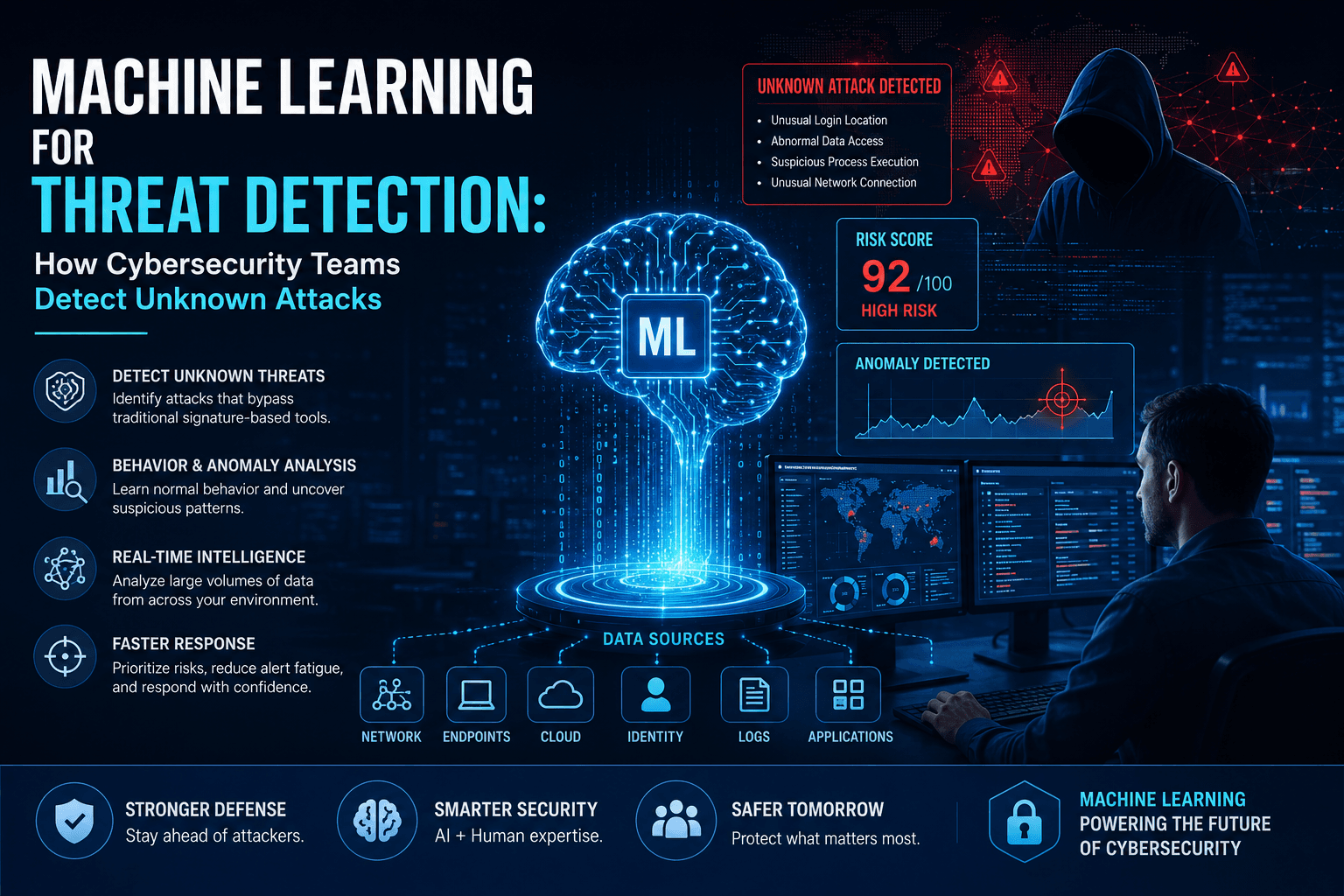
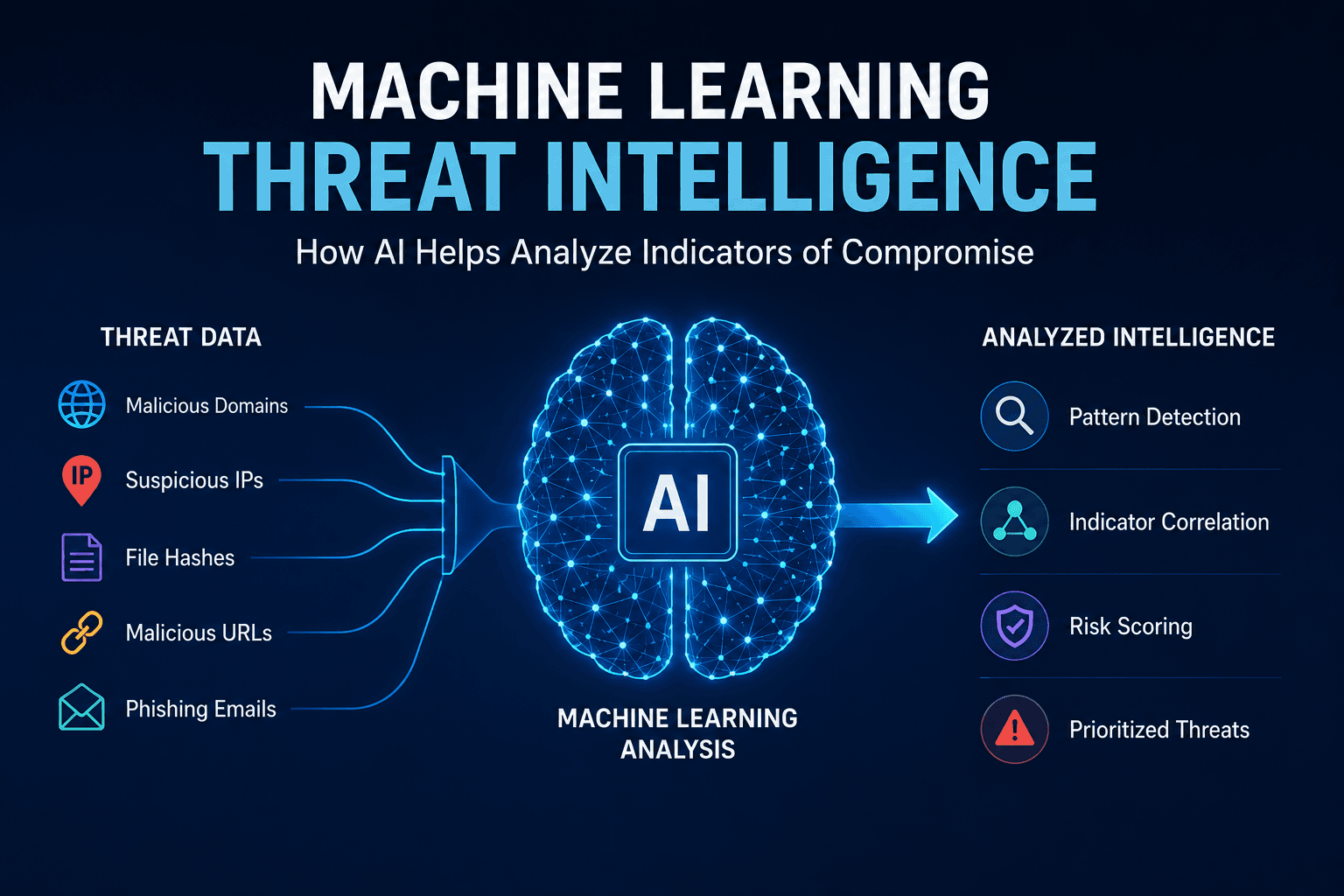
Machine learning threat intelligence is becoming an important capability for cybersecurity teams that need to analyze large volumes of threat data, detect attack patterns, and prioritize indicators of compromise. Indicators of compromise, often known as IOCs, include suspicious Internet Protocol addresses, malicious domains, file hashes, uniform resource locators, email addresses, malware signatures, registry changes, and abnormal system behaviors that may suggest cyber attack activity. Traditional threat intelligence analysis often depends on manual review, static reputation lists, and known threat feeds. Although these methods remain valuable, modern attackers constantly change infrastructure, rotate domains, modify malware, and use legitimate services to hide malicious activity. Threat intelligence machine learning improves this process by helping security teams classify indicators, discover relationships, identify suspicious patterns, and enrich security alerts with contextual risk. This article examines how artificial intelligence and machine learning support threat intelligence analysis, how cybersecurity teams use machine learning to analyze indicators of compromise, and why human analyst validation remains essential. The article concludes that machine learning does not replace threat intelligence professionals, but strengthens their ability to process complex data, detect emerging threats, and support faster security decisions.
Cybersecurity teams depend on threat intelligence to understand attackers, detect malicious activity, and respond to cyber risks. Threat intelligence provides information about adversary tactics, techniques, procedures, malware families, suspicious infrastructure, vulnerabilities, and indicators of compromise. These indicators help security teams identify whether a system, network, account, or application may be affected by malicious activity. However, threat intelligence has become more difficult to manage because the volume of security data continues to increase. Organizations receive information from open-source intelligence, commercial threat feeds, malware repositories, internal security logs, endpoint detection tools, phishing reports, cloud platforms, vulnerability databases, and incident response investigations. Manually reviewing all this information can be slow and inconsistent. Machine learning threat intelligence helps solve this challenge by applying artificial intelligence and machine learning techniques to threat data. Instead of relying only on static lists or manual analysis, machine learning can identify patterns, group related indicators, detect suspicious relationships, and assign risk scores to potential threats. Threat intelligence machine learning is especially useful because attackers frequently change their infrastructure. A malicious domain may disappear after a few hours. A phishing campaign may use hundreds of similar domains. A malware family may generate new file hashes daily. A command-and-control server may rotate across cloud hosting providers. Machine learning helps cybersecurity teams recognize these relationships even when individual indicators appear new or unfamiliar. For modern security operations, machine learning is not only a technical improvement. It is also a strategic capability that helps organizations improve visibility, reduce analyst workload, and respond to emerging threats more effectively.
Threat intelligence is information that helps organizations understand cyber threats and make better security decisions. It may describe who the attackers are, what tools they use, what systems they target, which vulnerabilities they exploit, and what evidence they leave behind. Indicators of compromise are specific pieces of evidence that may suggest malicious activity. Common examples include suspicious Internet Protocol addresses, malicious domains, file hashes, phishing uniform resource locators, attacker email addresses, malware filenames, registry modifications, unusual processes, command-and-control communication patterns, and abnormal login activity. For example, if a malware sample connects to a specific domain, that domain may become an indicator of compromise. If a phishing email contains a suspicious link, the link may become an indicator. If an endpoint creates an unusual process and modifies system files, those behaviors may also be treated as indicators. Indicators of compromise are valuable because they help cybersecurity teams detect and investigate attacks. Security tools can use indicators to block malicious traffic, search logs, identify compromised systems, and create detection rules. However, indicators can become outdated quickly. Attackers may change domains, rotate servers, modify malware, or use legitimate cloud services. Machine learning threat intelligence helps improve indicator analysis by looking beyond isolated indicators. Instead of asking only whether an Internet Protocol address is already known as malicious, machine learning can ask whether the address shares suspicious characteristics with known malicious infrastructure. This approach provides a broader and more adaptive way to detect threats.
Traditional indicator of compromise analysis usually relies on known threat feeds, blocklists, manual investigation, and rule-based detection. These methods are still important, but they have limitations in modern cybersecurity environments. One limitation is speed. Attackers can create and abandon infrastructure quickly. A phishing domain may be active for only a short period before being replaced. By the time a static threat feed identifies the domain as malicious, the attacker may already be using a new domain. Another limitation is scale. Security teams may receive thousands or millions of indicators from different sources. Some may be highly relevant, while others may be low confidence, duplicated, outdated, or unrelated to the organization. Manual review can become overwhelming. A third limitation is lack of context. An isolated Internet Protocol address, domain, or file hash does not always explain the full threat. Analysts need to understand relationships among indicators. For example, several domains may be connected to the same hosting provider, registration pattern, malware family, or phishing campaign. False positives also create challenges. Not every suspicious indicator is truly malicious. Some infrastructure may be shared by legitimate and malicious users. Some files may appear unusual but be safe. Some domains may be newly created for legitimate business purposes. Threat intelligence machine learning helps address these issues by analyzing patterns, scoring risk, grouping related indicators, and identifying suspicious relationships that may not be visible through manual review.
Machine learning supports threat intelligence by helping cybersecurity teams process, classify, enrich, and prioritize threat data. The process usually begins with data collection. Threat intelligence platforms may collect indicators from malware analysis systems, phishing reports, vulnerability databases, endpoint alerts, network logs, domain reputation feeds, and external intelligence providers. After collection, the data must be normalized. Different sources may use different formats, naming conventions, confidence levels, and timestamps. Machine learning can help organize this information and prepare it for analysis. Machine learning models can then identify patterns in the data. For example, a model may analyze domain names and detect that several domains use similar naming patterns associated with phishing. Another model may identify that multiple file hashes share behavioral characteristics with a known malware family. A network model may detect that several Internet Protocol addresses belong to infrastructure commonly used for command-and-control activity. Machine learning can also enrich indicators by connecting them with additional context. A domain may be enriched with registration data, hosting information, age, reputation, related domains, certificate information, and previous campaign history. This additional context helps analysts decide whether the indicator should be blocked, monitored, or investigated. Machine learning threat intelligence is most useful when it helps analysts move from raw data to actionable intelligence. Raw indicators alone are not enough. Security teams need prioritized, contextual, and explainable insights.
Malicious domains are common indicators of compromise in phishing, malware delivery, credential theft, and command-and-control operations. Attackers often register domains that look similar to legitimate brands, use random-looking characters, or rotate domains quickly to avoid detection. Machine learning can analyze domain characteristics to determine whether a domain appears suspicious. Features may include domain age, spelling patterns, length, use of numbers or hyphens, similarity to known brands, registration behavior, hosting provider, certificate information, and historical reputation. For example, a domain that looks visually similar to a major cloud provider and was registered recently may be suspicious. If the same domain also appears in phishing emails or resolves to infrastructure associated with previous attacks, the risk increases. Threat intelligence machine learning can also group related domains together. A phishing campaign may use many domains with similar structure. Individually, each domain may appear new and unknown. Together, the pattern may reveal a coordinated campaign. This type of analysis helps cybersecurity teams detect phishing infrastructure earlier and create better blocking rules before users are affected.
File hashes are commonly used as indicators of compromise. A file hash is a unique value created from a file. Security teams use hashes to identify known malware files. However, attackers can change malware slightly, which creates a new hash and may bypass hash-based detection. Machine learning improves malware-related threat intelligence by analyzing behavior and structure rather than depending only on exact hashes. A model may examine file metadata, imported libraries, code structure, execution behavior, system calls, registry changes, network communication, and process activity. For example, two malware files may have different hashes but similar behavior. Both may attempt to create persistence, disable security tools, connect to suspicious domains, and download additional payloads. Machine learning can recognize these similarities and associate the files with the same malware family or attack campaign. Machine learning threat intelligence can also help identify malware variants. Instead of treating every new hash as completely separate, machine learning can group related samples and help analysts understand whether a new file belongs to an existing threat family. This reduces manual analysis time and improves the ability to detect modified malware.
Suspicious Internet Protocol addresses are common indicators of compromise, but they can be difficult to interpret. An Internet Protocol address may be associated with malware, phishing, scanning, brute-force attacks, spam, proxy services, or cloud hosting. Some addresses are used by both legitimate and malicious users. Machine learning can analyze Internet Protocol address behavior by reviewing connection patterns, geographic location, hosting type, traffic volume, reputation history, port usage, relationship with other indicators, and past attack activity. For example, an address may not be listed as malicious in a threat feed. However, if it communicates with multiple compromised endpoints, appears in phishing campaigns, and shares infrastructure with known command-and-control servers, machine learning may assign a higher risk score. Threat intelligence machine learning can also identify clusters of related addresses. Attackers may use multiple servers from the same provider or network block. By finding patterns across infrastructure, machine learning helps analysts detect broader attacker operations rather than isolated indicators. This approach is especially useful for detecting emerging infrastructure before it becomes widely known.
One of the most valuable uses of machine learning threat intelligence is indicator prioritization. Security teams often receive more indicators than they can investigate manually. Without prioritization, analysts may waste time on low-value or outdated indicators while missing high-risk threats. Machine learning can assign risk scores based on multiple factors. These factors may include source reliability, indicator age, similarity to known threats, relationship with internal alerts, observed activity, geographic relevance, campaign association, and confidence level. For example, a domain from a low-confidence external feed may not require urgent action by itself. However, if internal logs show that company devices communicated with that domain, and the domain resembles known phishing infrastructure, the risk score may increase significantly. Machine learning can help analysts focus on indicators that are most relevant to the organization. This improves efficiency and reduces alert fatigue. It also supports faster decision-making in security operations centers. Prioritization is especially important during active incidents. When many indicators are discovered during an investigation, machine learning can help determine which indicators should be blocked immediately, which should be monitored, and which require deeper analysis.
Cyber attacks often involve multiple related indicators. A phishing campaign may use several domains, email accounts, hosting providers, uniform resource locators, malware files, and command-and-control servers. An advanced attack may involve reconnaissance, credential theft, lateral movement, persistence, and data exfiltration. Machine learning can help identify relationships among these indicators and connect them into larger threat campaigns. This is important because isolated indicators may not reveal the full attack. For example, several phishing domains may have similar registration dates, naming structures, hosting locations, and certificate patterns. Machine learning can group these domains together and identify them as part of a campaign. Analysts can then search for additional related domains and block them proactively. Another example involves malware infrastructure. Several file hashes may connect to different domains, but those domains may resolve to related Internet Protocol addresses. Machine learning can map these relationships and help analysts understand the attacker’s infrastructure. Threat intelligence machine learning helps transform scattered technical indicators into a more complete picture of attacker activity. This improves detection, investigation, and response.
Machine learning threat intelligence becomes most valuable when integrated into daily security operations. Security operations centers can use machine learning-enhanced intelligence to enrich alerts, prioritize investigations, update detection rules, and support incident response. For example, if an endpoint alert shows communication with an unknown domain, a threat intelligence platform can use machine learning to evaluate the domain’s risk. The system may review domain age, reputation, similarity to known malicious domains, hosting infrastructure, and related indicators. If the domain appears risky, the alert can be escalated. Machine learning can also help security teams reduce duplicate alerts. If multiple alerts relate to the same campaign or infrastructure, the system can group them together. This helps analysts investigate incidents more efficiently. Threat intelligence can also improve firewall rules, endpoint detection, email filtering, and cloud monitoring. When machine learning identifies high-risk indicators, security tools can use that intelligence to block or monitor suspicious activity. The goal is not only to collect more intelligence. The goal is to make intelligence actionable, relevant, and timely.
Machine learning threat intelligence provides several benefits for cybersecurity teams. First, it improves speed. Machine learning can process large amounts of threat data faster than manual analysis. This helps organizations detect emerging threats earlier. Second, it improves pattern recognition. Machine learning can identify relationships among domains, Internet Protocol addresses, file hashes, malware behaviors, and attacker infrastructure. These relationships may be difficult to identify manually. Third, it improves prioritization. Security teams often receive too many indicators. Machine learning can assign risk scores and help analysts focus on the indicators most relevant to their environment. Fourth, it improves detection of unknown threats. Even if an indicator has not been previously labeled as malicious, machine learning can identify suspicious characteristics or relationships. Fifth, it supports threat hunting. Analysts can use machine learning insights to search for related activity inside the organization’s environment. Sixth, it improves operational efficiency. By reducing manual review and grouping related indicators, machine learning helps analysts spend more time on investigation and response rather than raw data processing.
Although machine learning threat intelligence is powerful, it has limitations. One major limitation is data quality. Machine learning models depend on accurate, relevant, and timely data. If threat feeds contain outdated, duplicated, or low-confidence indicators, the model may produce poor results. Another limitation is false positives. A domain, file, or Internet Protocol address may appear suspicious but still be legitimate. Blocking indicators without validation can disrupt business operations. False negatives are also possible. Attackers may use legitimate infrastructure, compromised websites, encrypted traffic, or slow-changing behavior to avoid detection. Machine learning cannot identify every malicious indicator. Explainability is another challenge. Analysts need to understand why an indicator was assigned a high risk score. If the model cannot explain its reasoning, analysts may struggle to trust or validate the result. Machine learning models may also be targeted by attackers. Adversaries may attempt to poison data, manipulate indicators, or imitate legitimate behavior. This means organizations must secure the machine learning pipeline and monitor model performance. Finally, machine learning requires human expertise. It can support analysis, but it cannot fully replace the judgment of experienced threat intelligence analysts.
Organizations should follow best practices when implementing machine learning threat intelligence. First, they should collect threat data from reliable sources. High-quality data improves model accuracy and reduces false positives. Second, organizations should combine internal and external intelligence. External threat feeds provide broad visibility, while internal logs show what is actually happening inside the organization. Combining both sources helps determine which indicators are relevant. Third, security teams should require explainable scoring. Analysts need to understand why an indicator is considered risky. Useful context may include related indicators, source confidence, activity history, campaign association, and observed internal events. Fourth, machine learning should be integrated with existing security tools. Threat intelligence should support security information and event management platforms, endpoint detection tools, firewalls, email gateways, cloud security systems, and incident response workflows. Fifth, organizations should continuously validate model performance. Threat behavior changes over time, and models must be reviewed to ensure that detection remains accurate. Sixth, human analysts should review high-impact decisions. Automated blocking may be useful in some cases, but critical decisions should include analyst validation to prevent business disruption.
Machine learning threat intelligence works best when combined with human analyst expertise. Threat intelligence analysts understand attacker behavior, organizational context, business priorities, and incident response needs. Machine learning can process data quickly, but human analysts interpret the results. For example, a machine learning model may identify a suspicious domain. An analyst can review whether the domain appears in internal logs, whether users clicked related links, whether the domain is part of a known campaign, and whether blocking is appropriate. Human analysts also help improve machine learning systems by validating alerts, correcting false positives, adding context, and identifying gaps. Their feedback can improve future model performance. The strongest threat intelligence programs use machine learning as an enhancement rather than a replacement. Machine learning improves speed and scale, while analysts provide judgment and strategic understanding.
Machine learning threat intelligence provides strategic value by helping organizations move from reactive defense to proactive security. Instead of waiting for attacks to become obvious, organizations can use machine learning to identify suspicious indicators, detect emerging campaigns, and strengthen defenses earlier. This capability supports better risk management. Security leaders can understand which threats are most relevant to the organization, which indicators are active in the environment, and which systems may require urgent attention. Machine learning-enhanced threat intelligence also supports compliance and governance. Many organizations need to demonstrate that they monitor cyber threats, respond to incidents, and protect sensitive data. A structured threat intelligence program can support these requirements. For security operations teams, the strategic value is practical. Analysts can investigate faster, reduce noise, identify related threats, and prioritize response actions. For leadership, the value is improved visibility and stronger cyber resilience.
The future of machine learning threat intelligence will likely include deeper automation, better explainability, stronger integration with security operations centers, and greater use of artificial intelligence for threat analysis. As attackers use automation and artificial intelligence, defenders will need faster and more adaptive intelligence capabilities. Future systems may automatically connect indicators across malware, phishing, cloud activity, vulnerability exploitation, and endpoint behavior. They may generate clearer explanations, recommend response actions, and help analysts identify attack campaigns earlier. Machine learning may also play a greater role in analyzing threat reports, extracting indicators from text, mapping attacker tactics to frameworks, and identifying relationships across global attack activity. However, the future will also require responsible implementation. Organizations must protect data pipelines, validate intelligence sources, monitor models, and ensure that human analysts remain involved in important security decisions.
Machine learning threat intelligence is an important capability for modern cybersecurity teams. As attackers constantly change infrastructure, modify malware, rotate domains, and use legitimate services to hide activity, traditional indicator analysis alone may not be enough. Threat intelligence machine learning helps security teams analyze indicators of compromise more effectively by identifying suspicious patterns, grouping related indicators, assigning risk scores, and enriching alerts with context. It can improve analysis of domains, Internet Protocol addresses, file hashes, phishing links, malware behavior, and attacker infrastructure. The benefits include faster analysis, better prioritization, improved campaign detection, stronger threat hunting, and more actionable intelligence. However, limitations remain. Machine learning depends on quality data, may produce false positives, may miss sophisticated threats, and requires explainable results. The most effective approach combines machine learning, high-quality intelligence sources, skilled analysts, security operations workflows, and continuous validation. When implemented carefully, machine learning threat intelligence helps organizations detect emerging threats earlier, investigate incidents faster, and build stronger cyber defense.