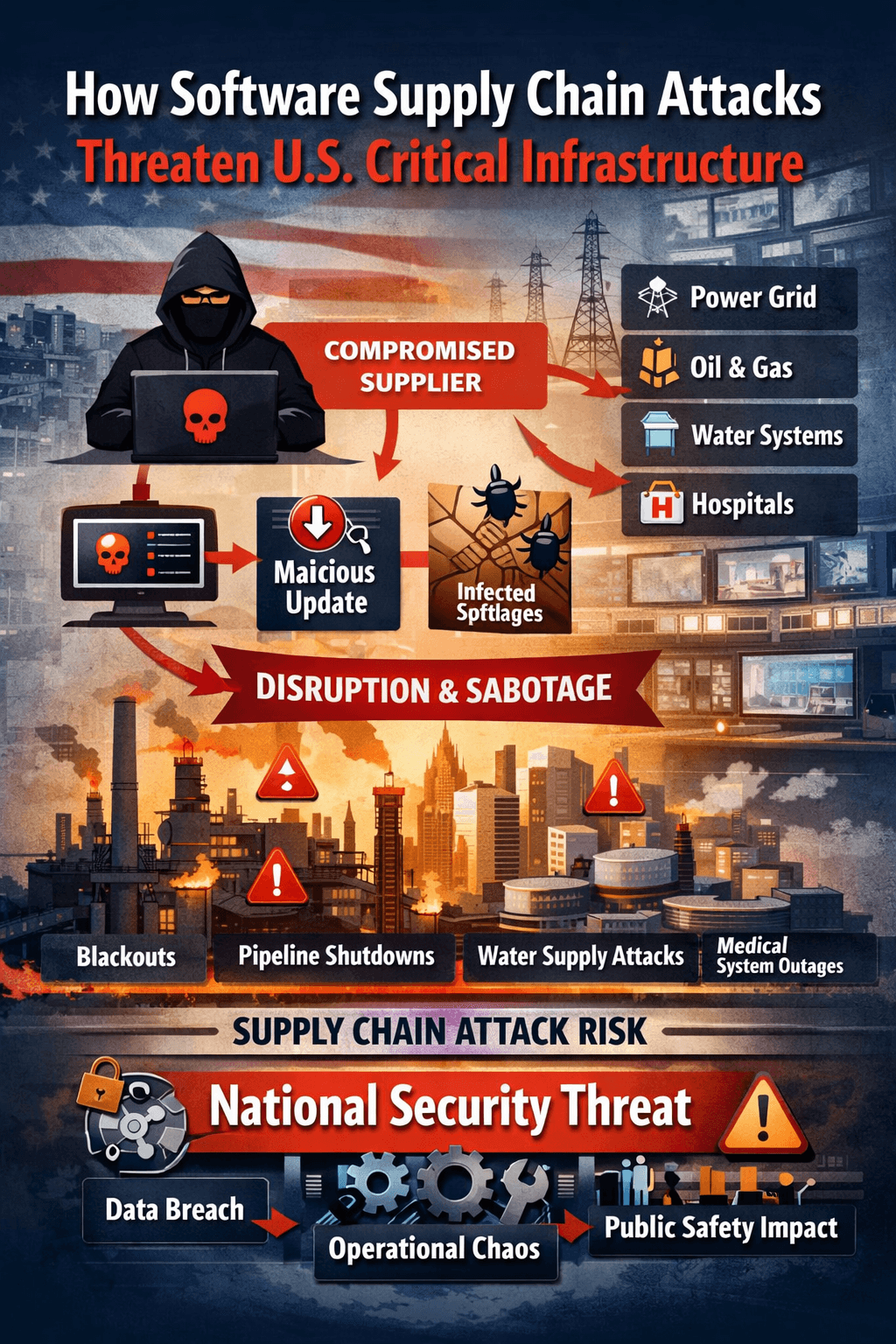
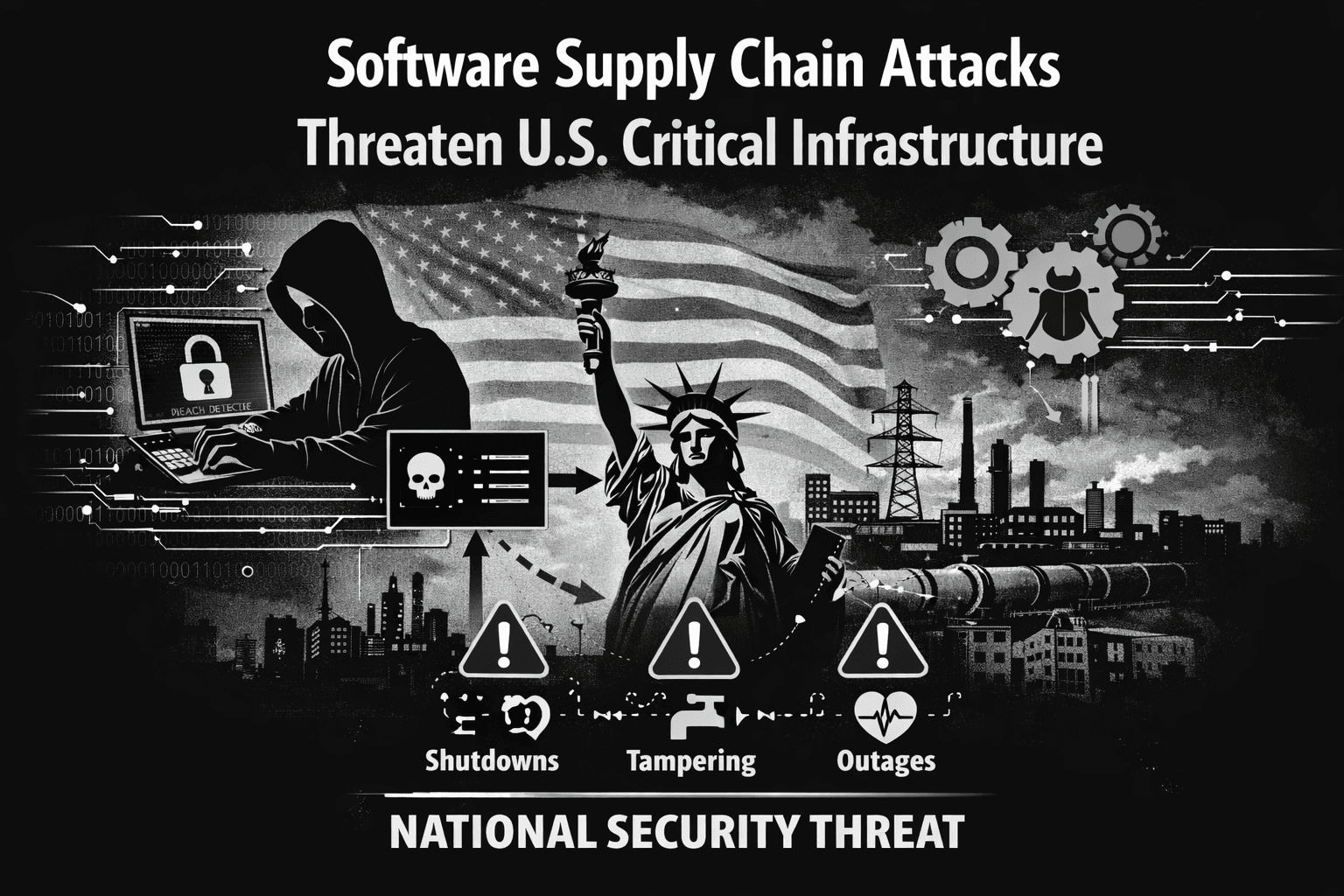
Supply chain attacks succeed because they exploit trust and scale.
Critical infrastructure operators must trust vendors. They buy systems, install updates, and rely on tools that are often signed, supported, and considered "safe" compared to random downloads. When the trust anchor is compromised (a vendor build system, a signing key, an update channel), the attacker's code can pass through defenses that are designed to stop untrusted software. The victim isn't "making a mistake"—they are doing normal operations, like patching.
A direct attack on one utility is hard. A supply chain compromise can affect hundreds or thousands of customers at once. Attackers get a one-to-many advantage, turning a single vendor weakness into national-level exposure. This scale is especially concerning for infrastructure sectors that share common vendors—network management tools, identity providers, endpoint agents, OT monitoring solutions, engineering workstations, and industrial software suites. The more standardized the ecosystem, the bigger the blast radius.
Critical infrastructure faces constraints that make supply chain threats more dangerous than in typical IT environments. 1) Long technology lifecycles and patch friction Operational Technology (OT) and industrial systems are designed to run for decades. Many environments still depend on older operating systems, specialized hardware, or vendor-validated configurations. Patching isn't always simple. Updates might require: * scheduled downtime, * safety validations, * production coordination, * regulatory compliance steps, * vendor support windows. Attackers love slow patch cycles. A compromised component can remain in place longer, increasing dwell time and impact. 2) IT/OT convergence Historically, industrial systems were isolated. Today, they are connected for remote operations, centralized monitoring, analytics, and efficiency. That convergence increases exposure: a supply chain compromise that starts in IT can potentially pivot into OT if segmentation is weak. 3) Complex vendor ecosystems Critical infrastructure organizations rely on many suppliers: equipment vendors, software vendors, integrators, cloud providers, contractors, MSPs, and consultants. Each relationship adds possible entry points, and not all vendors have mature secure development practices. 4) High-impact outcomes and cascading failures The consequences of compromise are uniquely severe: * Power disruptions can ripple into water supply, communications, healthcare, and transportation. * Hospital outages can delay care and affect patient safety. * Fuel or logistics disruptions can affect entire regions and supply networks. * Telecommunications disruptions can reduce coordination during emergencies. Supply chain attacks don't need to "blow up" infrastructure to create national harm. Simply forcing mass shutdowns, incident response, patching, and system rebuilds can generate serious disruption.
Supply chain attacks take many forms, but most fall into several recurring patterns. Path A: Compromised vendor update mechanisms This is the classic "poisoned update" scenario: attackers compromise the vendor's build or distribution channel and ship a malicious update that customers install. Why this is deadly: * Updates are expected and often automated. * Signed software can bypass many controls. * "Normal" vendor traffic looks legitimate. If the compromised product is a management platform (monitoring, endpoint management, identity, remote admin), the attacker can gain privileged access quickly. Path B: Build pipeline and CI/CD compromise Instead of modifying source code (where changes may be reviewed), attackers compromise CI/CD systems and inject malicious code into the final build artifacts. This approach has strong advantages for attackers: * It can evade code review. * It can create "clean" repos but "dirty" binaries. * It targets the core of software integrity: the build process. When critical infrastructure vendors have weak build security—shared credentials, poor segmentation, inadequate signing key protection—the risk increases dramatically. Path C: Open-source dependency compromise Modern products embed open-source libraries deeply. Attackers exploit this by: * publishing malicious packages, * hijacking dormant projects, * compromising maintainer accounts, * typosquatting popular package names, * injecting backdoors into dependencies. The danger isn't only direct usage. It's transitive dependencies—libraries pulled in indirectly—often without the operator even knowing they exist. Path D: Managed service provider (MSP) or integrator compromise Many infrastructure organizations outsource key functions like endpoint monitoring, patching, remote support, or network administration. MSP tools are designed for broad access, and compromise can allow attackers to pivot across many clients. The supply chain isn't only "software you install." It's also "who operates and manages your systems" and "what privileged tools they use." Path E: Compromised signing keys and certificates Code signing is meant to guarantee authenticity. But if attackers steal signing keys, they can ship malware that appears legitimate. For defenders, this is painful: revoking certificates can break trust for real software, and certificate rotation across large environments can be slow.
Supply chain access is usually the beginning, not the end. Once attackers get in, they can pursue multiple objectives. 1) Espionage and long-term access (pre-positioning) Some adversaries focus on persistence: staying inside networks quietly to collect intelligence, map systems, identify operational dependencies, and gain leverage. Critical infrastructure is a national security target. Even if attackers do not immediately disrupt services, supply chain compromise can enable "pre-positioning" for future crisis leverage. 2) Ransomware and extortion Supply chain compromise can be used to deploy ransomware broadly. Infrastructure operators may be pressured to pay because downtime costs are enormous and public impact is severe. Even when backups exist, the recovery process in OT/ICS settings may be complex, slow, and risky—especially if safety systems and operational continuity are involved. 3) Operational disruption, sabotage, or safety impacts In the worst cases, attackers pivot into OT networks and manipulate industrial processes: * changing setpoints, * disabling monitoring, * tampering with safety controllers, * causing equipment damage or shutdowns. Not every incident reaches this stage—but supply chain compromise increases the probability by giving adversaries stealthy access and time to move laterally. 4) Indirect disruption through incident response itself Even if the attacker's intent is espionage, a supply chain incident can still disrupt operations. Organizations may: * shut down systems as a precaution, * halt updates across fleets, * isolate networks, * rebuild thousands of endpoints, * rotate credentials and certificates. At critical infrastructure scale, remediation becomes a major operational event.
Supply chain attacks often evade detection for longer because they blend into normal operations. * Legitimate process abuse: The "malware" arrives through normal patching, normal vendor infrastructure, normal signed binaries. * Low-noise initial behavior: Sophisticated supply chain attacks frequently focus on stealth—limited beacons, careful lateral movement, and selective targeting. * Trusted tool positioning: Compromised management tools already have privileged access and expected network activity, so anomalies are less obvious. * Limited visibility into component provenance: Many organizations cannot quickly verify what was built where, by whom, and from what sources. This makes traditional perimeter defense insufficient. The problem is not just "keep attackers out." It's "prove that what you run is what you intended to run."
Supply chain attacks are not merely a technical issue. They are a strategic risk because they can: 1. Create systemic exposure across multiple infrastructure sectors at once. 2. Enable covert access to sensitive operational networks and data. 3. Undermine trust in patching, software updates, and vendor relationships. 4. Increase cost and complexity of modernization (organizations become fearful of updates). 5. Provide crisis leverage for adversaries during geopolitical tension. For a country as interconnected as the United States, the infrastructure "system of systems" means that cyber risk is also interdependent. A compromise in one sector can cascade into others.
There is no single "magic control," but strong supply chain defense follows a layered strategy across procurement, engineering, and operations. 1) Software and asset visibility: know what you run You need practical, continuously maintained inventories of: * critical systems and their dependencies, * versions and patch states, * network placement (IT vs OT), * ownership and operational criticality. The faster you can answer "Where is this software deployed?" the faster you can respond when a vendor incident occurs. 2) SBOM and transparency (but used realistically) A Software Bill of Materials (SBOM) helps organizations understand what components are inside software. SBOMs are not a cure-all, but they improve response speed and risk assessment when a vulnerability or compromise is discovered in a component. The key is operationalizing SBOM: * mapping components to deployed systems, * monitoring for vulnerable components, * integrating with procurement and vendor requirements. 3) Secure development practices and vendor accountability Critical infrastructure operators should demand stronger assurance from vendors: * secure SDLC practices, * dependency governance, * build pipeline security, * signing key protection, * vulnerability disclosure programs, * patch integrity and update transparency. This is not about paperwork. It's about measurable, auditable practices that reduce compromise likelihood. 4) Zero trust principles and segmentation to limit blast radius Supply chain compromise often succeeds at entry. The question becomes: can you prevent it from becoming a catastrophe? * Strong identity security (MFA, least privilege, privileged access management) * Tight segmentation between IT and OT networks * Restricted egress rules for management tools * Continuous monitoring for unusual behavior from "trusted" systems In other words: assume something trusted might be compromised, and design networks to contain it. 5) Provenance and integrity verification for critical software Where possible, organizations should adopt stronger integrity measures: * artifact signing and verification, * protected build environments, * reproducible builds (when feasible), * monitoring for signing anomalies, * controlled deployment (canary rollouts, staged updates). If your organization builds software internally—even scripts and automation used in OT contexts—treat your own pipeline as part of the supply chain. 6) Incident readiness focused on supplier compromise A supply chain incident can require urgent action at scale. Preparation matters: * tabletop exercises focused on "vendor compromise" * playbooks for certificate rotation and credential resets * isolation procedures for critical management platforms * backup and recovery drills, including OT-safe restoration You don't want to invent these steps during a crisis.
Historically, organizations treated vendor software as inherently trusted. The new reality requires a different mindset: * Trust must be earned and continuously revalidated. * Updates must be verified and controlled, not blindly auto-deployed. * High-privilege tools must be segmented and monitored like critical assets. * Vendor relationships must be managed as extensions of your security boundary. This isn't anti-vendor. It's pro-resilience. Even good vendors can be compromised, and attackers increasingly target those upstream relationships because it gives them reach.
Software supply chain attacks are dangerous because they exploit the foundational assumption that trusted software is safe. They turn routine operations—installing updates, using dependencies, relying on managed services—into a potential compromise pathway. For U.S. critical infrastructure, the stakes are enormous. An incident can cause public safety risks, massive economic disruption, and cascading failures that reach far beyond a single organization. These attacks also create strategic national security risk by enabling stealthy access and long-term pre-positioning across essential services. Defending against supply chain threats is not a single tool or compliance checkbox. It is a program: visibility, vendor accountability, secure engineering, integrity verification, segmentation, and practiced incident response. The goal is to ensure that when trust is attacked—as it increasingly will be—the impact is contained, recoverable, and resilient.